Tomb of Ramesses IV The pharaoh Ramesses IV was buried in Tomb KV2, located in the Valley of the Kings, Egypt. The tombs of Ramesses II and VII are on either side. Ramesses died at the age of 27 in 1148 BC. He is connected to the Temple of Khonsu at Karnak. Coordinates 25.741530,32.602080 Description The tomb is of similar design to others in that it has a corridor to the burial chamber with side rooms. It is thought to be about 75 metres long and declines about 10 metres from the entrance. Chamber E, as the antechamber, has stars painted on the ceiling. Chamber K is built with side rooms, and the burial chamber J has a vaulted ceiling with astrological patterns along with the sarcophagus. Coptic monks were said to have lived in the tomb, and in the 19th century, explorers like Jean-François Champollion had camped there. Earlier, Romans were said to have left what is considered as graffiti in the tomb. Measurements These are the tombs' measurements in metres, including the a...
Pyramid slope angles
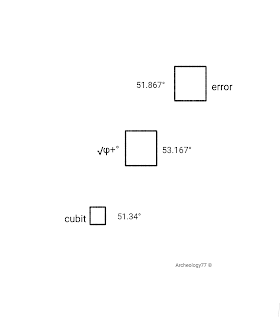
What are the slope angles and their relationship?
Spheres
Although the circumference at the equator is 40075 km, it is 34707 km at 29.97° latitude.
40075×cos(30)=34705.968
This suggests that measurements were made at the equator, and then spheres were understood.
Slopes
It has been shown that the building height-to-base ratio was 5.5:7, although the slopes varied.
Khafre's pyramid=53.167°
51.843+√(1.618)=53.115
53.115−53.167=0.052
Difference off the construction ratio of 5.5×7 (11×7) is equal to the √φ plus separation angle 0.05.
Khufu's pyramid=51.867°
51.867-51.843=0.024
Difference off 5.5×7 (11×7) ratio
Menkaure's pyramid=51.34°
51.843−51.34=0.503
0.503-0.523=0.02
(51.34+1.323)−53.167=0.504
Subtract Menkaure's slope from the difference between Khafre's slope and the ratio of 5.5 × 7 (11 × 7). Then, subtract the result from Khafre's slope to get 0.504, which is 28 × 1.8 cm. Adding 1.912 cm gives 0.523 metres.
This relies on accurate measurements already taken. Menkaure's slope is very near to this number already, but using the numbers as measured shows that

What are the slope angles and their relationship?
There are two area equations that possibly give the number of blocks contained within a pyramid.
The area of the triangle between the Earth and the Sun and another from the pyramid's separation distance and the angle produced (Meidum, Khufu's).
A circumference was probably deduced initially, followed by a time scale splitting the day into 24 hrs × 60 minutes.
Area Sun÷Area larger=area perimeter 69202799999.9÷29600=2337932.432
922.704 kms×150000000 kms×90°
64.197 kms×922.704 kms×3.989°
No one has yet added up the total number of blocks inside the pyramids, but the estimated number is around 2.4 million.
Speed of light
As for simultaneous equations, eliminating 8.31 minutes, the speed of light could be calculated as the only unknown.
8.31 minutes=511 seconds
(511×0.4651)=(150000000÷c) 1÷((237.6661÷0.4651)÷150000000)=293542.07 293542.074÷299792.458=98%
This produces a number which is 98% of the current value.
Area Sun÷Area larger=area perimeter 69202799999.9÷29600=2337932.432
922.704 kms×150000000 kms×90°
64.197 kms×922.704 kms×3.989°
No one has yet added up the total number of blocks inside the pyramids, but the estimated number is around 2.4 million.
Speed of light
As for simultaneous equations, eliminating 8.31 minutes, the speed of light could be calculated as the only unknown.
8.31 minutes=511 seconds
(511×0.4651)=(150000000÷c) 1÷((237.6661÷0.4651)÷150000000)=293542.07 293542.074÷299792.458=98%
This produces a number which is 98% of the current value.
Spheres
Although the circumference at the equator is 40075 km, it is 34707 km at 29.97° latitude.
40075×cos(30)=34705.968
This suggests that measurements were made at the equator, and then spheres were understood.
Slopes
It has been shown that the building height-to-base ratio was 5.5:7, although the slopes varied.
Khafre's pyramid=53.167°
51.843+√(1.618)=53.115
53.115−53.167=0.052
Difference off the construction ratio of 5.5×7 (11×7) is equal to the √φ plus separation angle 0.05.
Khufu's pyramid=51.867°
51.867-51.843=0.024
Difference off 5.5×7 (11×7) ratio
Menkaure's pyramid=51.34°
51.843−51.34=0.503
0.503-0.523=0.02
(51.34+1.323)−53.167=0.504
Subtract Menkaure's slope from the difference between Khafre's slope and the ratio of 5.5 × 7 (11 × 7). Then, subtract the result from Khafre's slope to get 0.504, which is 28 × 1.8 cm. Adding 1.912 cm gives 0.523 metres.
This relies on accurate measurements already taken. Menkaure's slope is very near to this number already, but using the numbers as measured shows that
(Menkaure slope + difference Khafre slope) - Khafre slope = 0.504 + 0.01912 = 0.523
Likewise,
Likewise,
Khufu's slope is 0.024° off the 5.5 × 7 (11 × 7) ratio, but along a 239-cubit base at 0.024°, the variation is 0.1 cubit, as an example.
Here, Khafre's pyramid's difference of 5.5 × 7 (11 × 7) ratio plus the square root of the golden ratio is about 0.05, which is the separation angle between it and Khufu's pyramid. The number is 0.052°, and this increases the angle-year ratio to 33.55 years, adjusting it by 1.3 years but keeping it within the 2040–2055 range, maintaining 1.912.
Old number 2046.2−32.25−1984.95=29
New number 2046.2−33.55−1984.95=27.7
Most likely 2046.2−32.25−1984.95−1.3=27.7
The most likely explanation is probably correct, as 1.3 years is equal to 15 months, which was the duration of the peak. It is also possible that at a distance of 1000 metres, a 0.05°/0.052° difference is equal to 3.49 cm. However, in metres, dividing by 10 is very similar to 0.349°, which is the angle that the Sphinx is off from east/west at peak.
(As a rule, Khufu’s pyramid connects to the error of offset for Menkaure’s pyramid with Khafre’s connecting with golden ratio plus offset and Menkaure’s connecting with the cubit, with all connecting with the 5.5×11 ratio.)
Ratio
Archeology77 ©
Here, Khafre's pyramid's difference of 5.5 × 7 (11 × 7) ratio plus the square root of the golden ratio is about 0.05, which is the separation angle between it and Khufu's pyramid. The number is 0.052°, and this increases the angle-year ratio to 33.55 years, adjusting it by 1.3 years but keeping it within the 2040–2055 range, maintaining 1.912.
Old number 2046.2−32.25−1984.95=29
New number 2046.2−33.55−1984.95=27.7
Most likely 2046.2−32.25−1984.95−1.3=27.7
The most likely explanation is probably correct, as 1.3 years is equal to 15 months, which was the duration of the peak. It is also possible that at a distance of 1000 metres, a 0.05°/0.052° difference is equal to 3.49 cm. However, in metres, dividing by 10 is very similar to 0.349°, which is the angle that the Sphinx is off from east/west at peak.
(As a rule, Khufu’s pyramid connects to the error of offset for Menkaure’s pyramid with Khafre’s connecting with golden ratio plus offset and Menkaure’s connecting with the cubit, with all connecting with the 5.5×11 ratio.)
Ratio
Archeology77 ©
Comments
Post a Comment